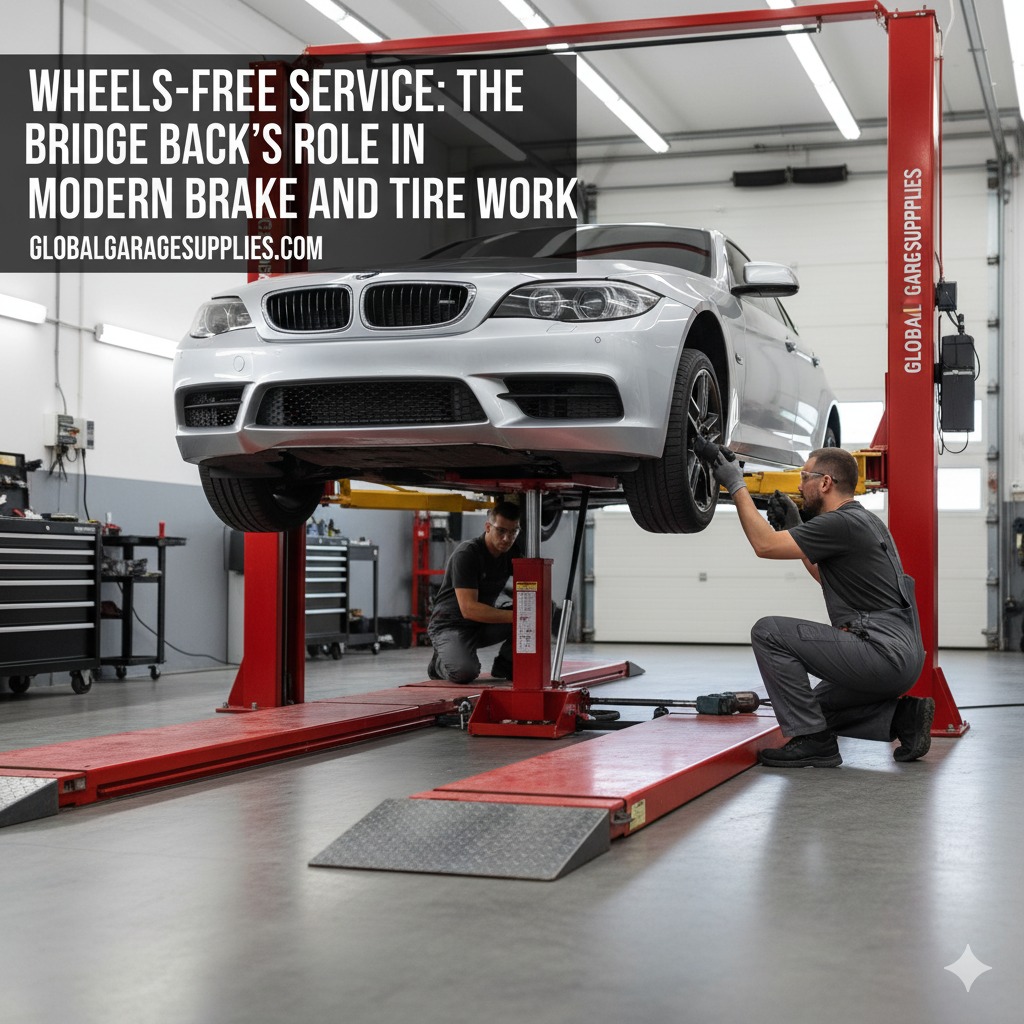
A Four Post Lift is only truly complete when paired with a Four Post Bridge Jack, allowing you to perform crucial wheels-free service. However, once you decide to upgrade, you face a key operational question: Should you choose a manual hydraulic or an air-powered bridge jack?
The right choice depends heavily on your shop’s existing infrastructure, technician preferences, and the sheer volume of brake and suspension work you perform. At Global Garage Supplies, we offer high-quality options in both categories. This guide will help you compare the two types to find the perfect workflow match for your business.
Operational Comparison: Hydraulic vs. Air-Powered
| Feature | Air-Powered Bridge Jack | Hydraulic (Manual) Bridge Jack |
| Lifting Speed | Fastest: Lifts and lowers quickly via air pressure. | Slower: Requires manual pumping to raise the load. |
| Technician Effort | Minimal Strain: Operation is nearly effortless. | High Effort: Requires manual work to lift the load. |
| Control/Precision | Good, but can be limited by air line pressure. | Excellent: Offers highly precise, metered lowering control. |
| Dependency | Requires a functioning, high-volume air compressor. | Completely self-contained; works without shop air. |
| Best For | High-volume shops focusing on speed. | Low-to-medium volume, or bays with limited air capacity. |
Air-Powered Bridge Jacks: The Speed Advantage
Air-powered (or air-hydraulic) bridge jacks use the shop’s existing compressed air to power the lift cylinder. They are the clear choice for high-throughput operations.
- Pros:
- Maximum Speed: The lift is almost instantaneous, saving valuable minutes per job—ideal for high-volume tire or brake services.
- Reduced Fatigue: Technicians avoid the physical strain of manual pumping, keeping them fresh for complex work.
- Cons:
- Air Dependency: Requires a large-capacity air compressor and consistent air pressure. If your shop air goes down, the jack is out of commission.
- Initial Cost: Often carry a slightly higher initial purchase price than manual hydraulic models.
Hydraulic Bridge Jacks: The Precision Advantage
Manual hydraulic bridge jacks use a built-in pump handle to physically generate the pressure needed to lift the vehicle.
- Pros:
- Ultimate Control: Technicians get precise, tactile control over lifting and, more importantly, lowering the load, which is critical for complex suspension work.
- Infrastructure Independence: Since they don’t require external air, they are perfect for specialty bays, remote installation areas, or shops with aging air systems.
- Lower Maintenance: Fewer external connections (no air lines) means less to inspect and maintain.
- Cons:
- Slower Operation: The time spent manually pumping can be a bottleneck in high-volume environments.
- Technician Strain: Requires physical effort, which can be tiring over a long shift.
Making the Right Workflow Decision
To select the best jack for your shop, ask yourself these three questions:
- What is your volume? If you are running 8+ brake/tire jobs per day, the time savings of an air-powered jack quickly justify the cost.
- What is your air capacity? If your compressor is already struggling to keep up with impact guns and other tools, choose a hydraulic jack to avoid system overload.
- What is the primary use? If the jack will be primarily used for precision suspension diagnosis, the fine control of a manual hydraulic unit may be preferred by your technicians.
Find the perfect workflow match—compare our hydraulic and air-powered bridge jacks and complete your four-post lift system today at Global Garage Supplies.